Portable vs. Permanent Rooftop Guardrail: How to Choose the Right System
When considering the right guardrail system for your application, it’s important to understand a key distinction that exists between portable/panel guardrail and permanent/component guardrail. Portable panel guardrail is usually the better fit when a system needs to install quickly, use repeatable straight sections, and remain available for relocation or reconfiguration. Permanent component guardrail is usually better when high rigidity is required, when it does not need to be moved, or if the layout must follow corners, elevation changes, parapets, roof crickets, equipment, or architectural requirements.
That does not mean every portable system is temporary or every permanent system must penetrate the roof. A ballasted panel system can remain in place for years, and a custom component system can use either ballasted bases or positive attachment.
The useful question is not simply, “Do we want portable or permanent?” It is, “Which system fits the hazard, roof, work pattern, and expected service life with the fewest compromises?”
The main difference is how the system is built
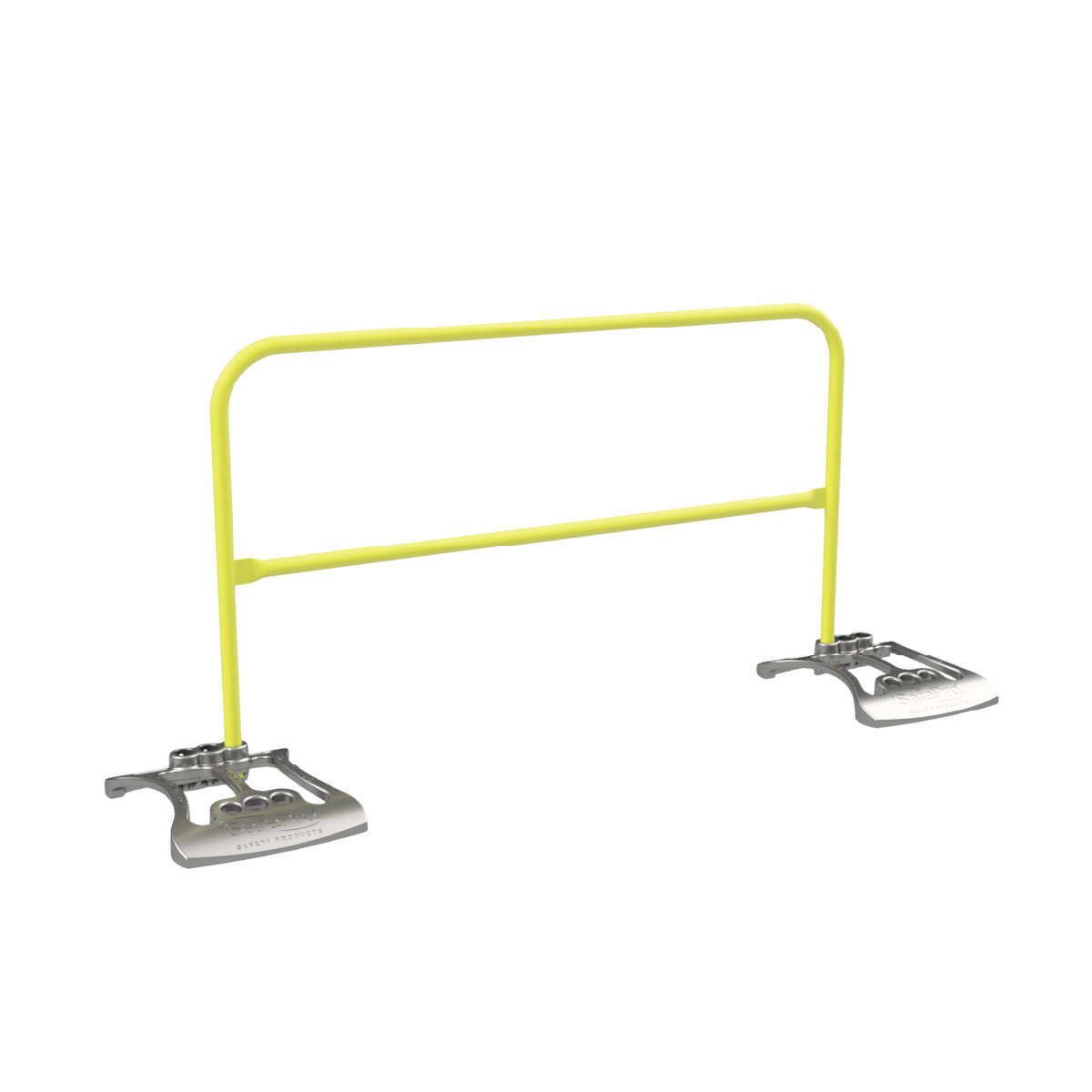
Portable rooftop guardrail generally uses prefabricated panels placed into weighted bases. The panel already contains its posts, top rail, and midrail. Installation is largely a matter of laying out the bases, setting the panels, and securing the connections according to the manufacturer’s instructions.
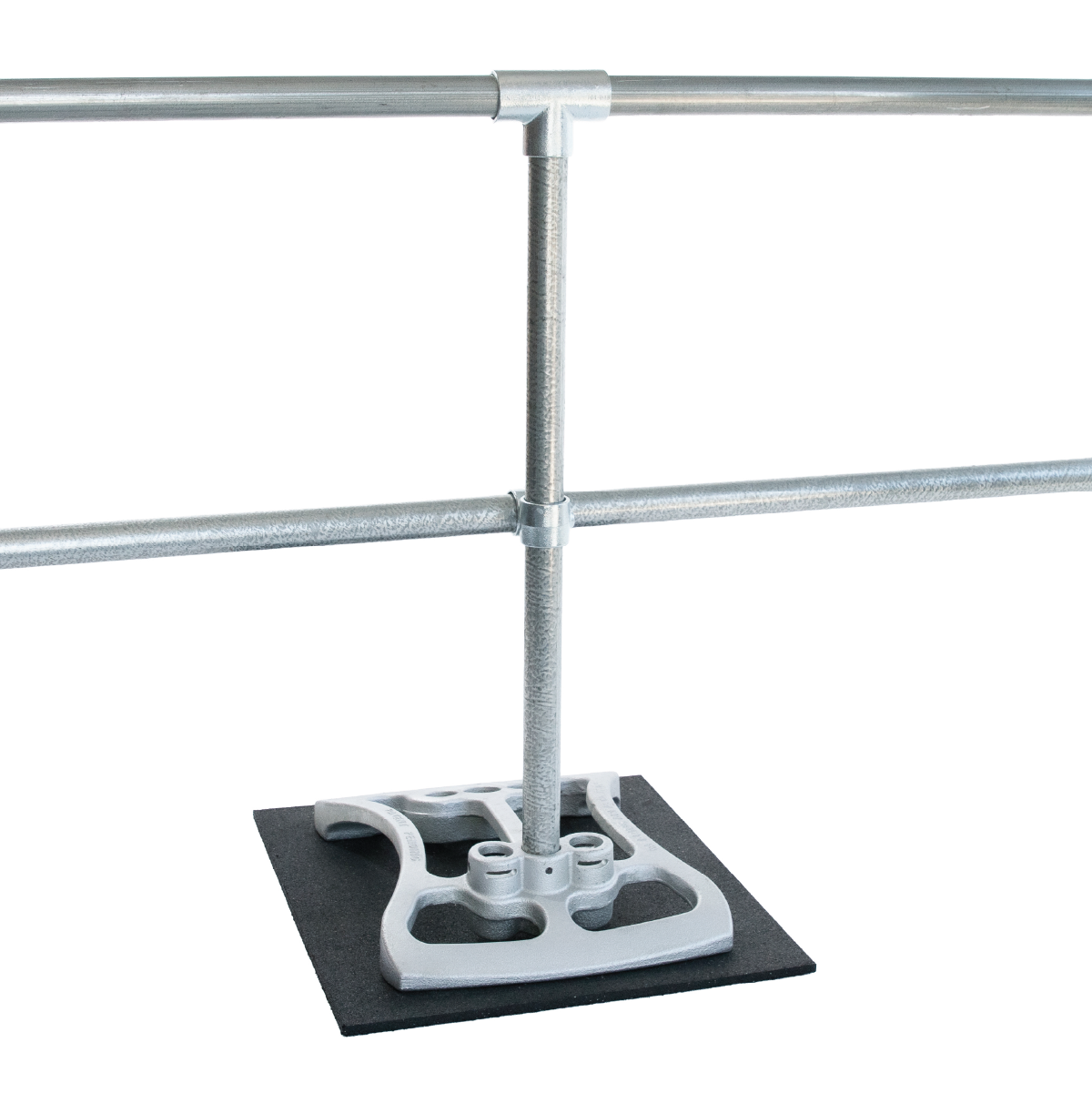
Component guardrail is assembled from separate posts, top rails, midrails, fittings, and bases or mounts. That requires more field layout and assembly, but it allows the system to follow conditions that standard panels cannot handle cleanly and makes the system much more rigid.
| Factor | Portable panel guardrail | Permanent component guardrail |
| Basic construction | Prefabricated rail panels and ballasted bases | Separate pipe, posts, fittings, and selected bases or mounts |
| Typical mounting | Non-penetrating ballast | Ballasted or positively attached |
| Layout | Fastest on straight, repeatable runs or simple corners | Adapts to corners, slopes, offsets, and complex geometry |
| Relocation | Designed to be moved or reconfigured | Usually intended to remain in its designed location |
| Visual options | Standard upright profile | Upright or contoured configurations may be available |
| Field labor | Less cutting and fitting | More layout, fitting, and adjustment |
| Best use | Temporary hazards, changing work areas, straightforward perimeter runs | Long-term protection and custom rooftop layouts |
When portable panel guardrail makes sense
Portable guardrail is often the most efficient answer for a clearly defined hazard with a relatively simple layout.
Common applications include:
- Straight roof edges
- Temporary projects and maintenance shutdowns
- Skylights, roof hatches, and equipment areas
- Areas where the protected boundary may change
- Facilities that want to store and redeploy the system
- Roofs where membrane penetration is undesirable
- Material-only projects where straightforward assembly is valuable
The prefabricated format reduces the number of field-built connections. It also makes it easier to inventory the system by panel length and base quantity.
SafePro Panel Guardrail is available in 6-, 8-, and 10-foot sections, giving it additional versatility in installation. It uses stackable ballasted bases and is available in safety-yellow powder coat or hot-dip galvanized finishes. The sections can be added, removed, stored, or repositioned as the application changes.
Portable does not mean casual. The system still needs a manufacturer-approved layout, correct base orientation, secure connections, a suitable roof surface, and evaluation for project-specific conditions.
When component guardrail is the better choice
Component guardrail earns its extra planning and assembly time on roofs that do not cooperate with standard panels, or where a more rigid long-term solution is needed.
It is often the better fit for:
- Perimeters with frequent direction changes
- Roof crickets, drainage slopes, and elevation changes
- Sites that require vertical or horizontal structural attachment
- Equipment screens, pipe runs, and other obstructions
- Long-term access routes and recurring work areas
- Projects requiring a lower visual profile from the ground
- Projects that need a cleaner, site-specific finished appearance
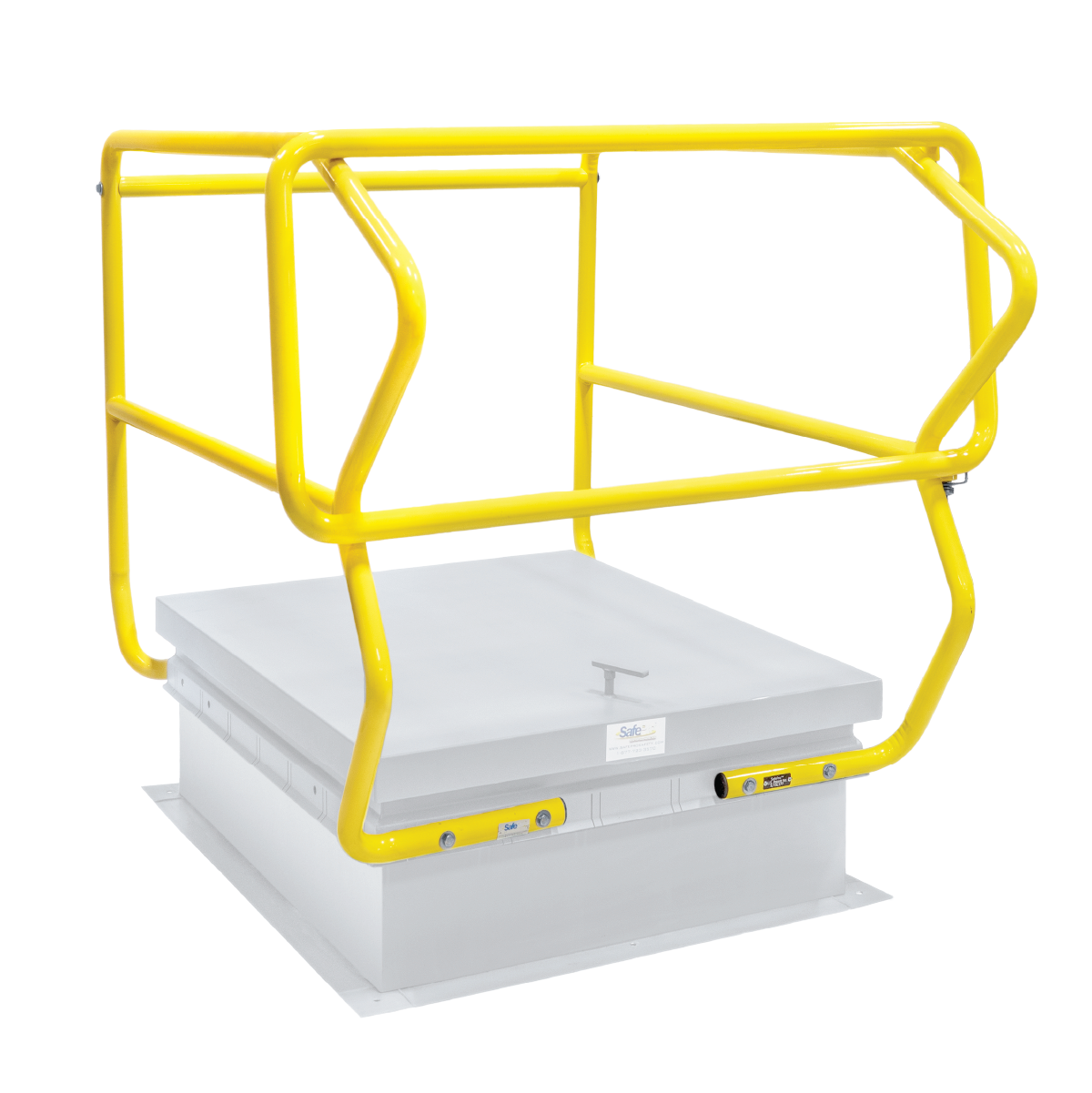
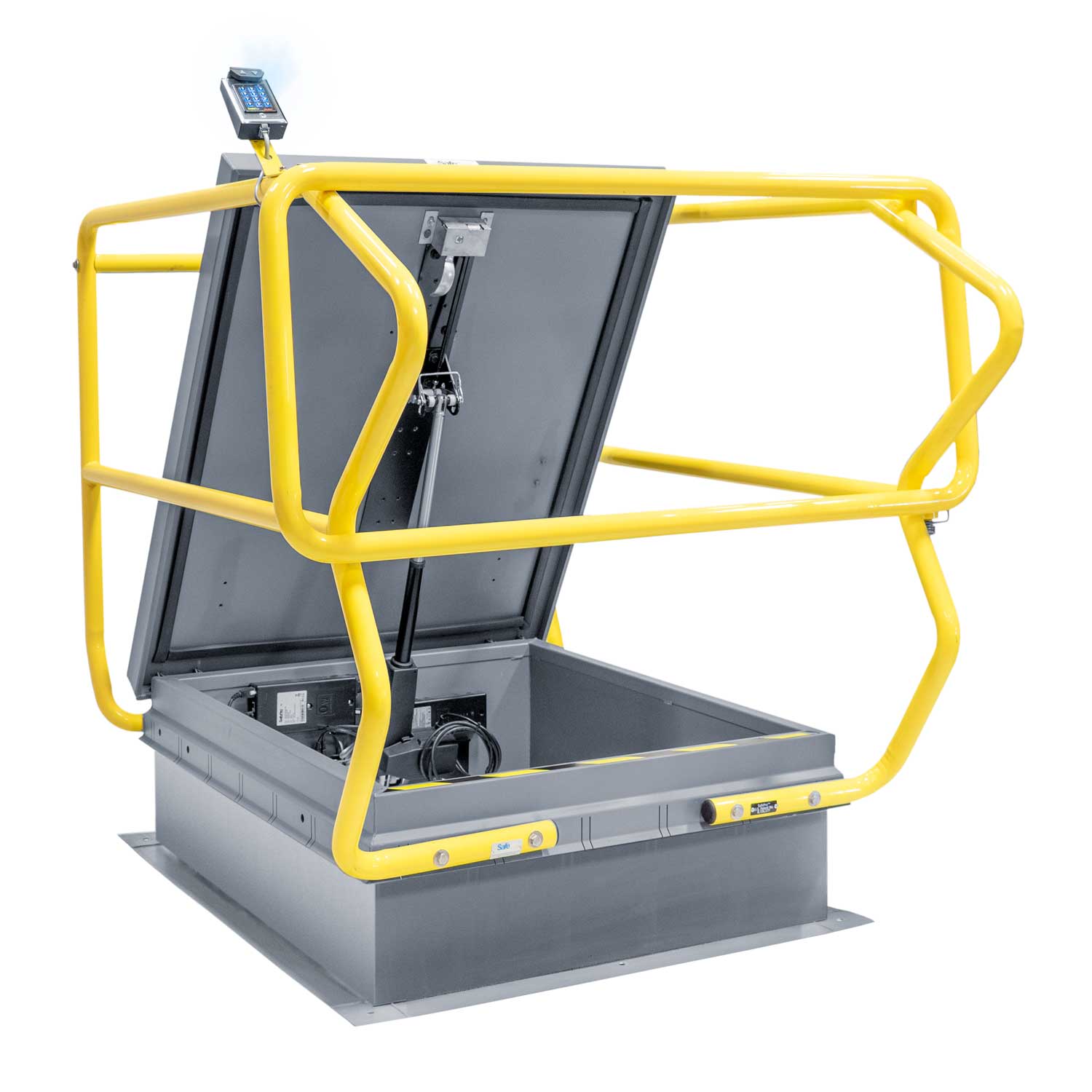
Because the rails and fittings are assembled separately, each connection can be positioned for the actual geometry. A contoured configuration can move the rails back from the roof edge, reducing visibility from ground level while preserving the required protected area.
SafePro Component Guardrail uses pipe and fittings and can be configured as upright or contoured. Depending on the project, it can use non-penetrating ballasted bases or a fixed mounting method.
Positively attached systems require different coordination
A fixed guardrail transfers loads into the structure through its mounts and fasteners. It can be attached horizontally to a roof surface, such as a traditional membrane or standing-seam roof, or to a vertical surface, such as a wall. It can be well suited to permanent layouts, but it requires confirmation of the supporting substrate and a waterproofing detail appropriate for the roof assembly.
That normally involves coordination among the guardrail manufacturer, building owner, roofing contractor, and, where necessary, a structural professional.
Important questions include:
- What structural material receives the fasteners?
- Is the proposed mount approved for that substrate?
- Who is responsible for waterproofing penetrations?
- Will the work affect an existing roof warranty?
- Can the system be inspected and repaired without removing major roof components?
- Does the mount interfere with drainage, flashing, or future reroofing?
Positive attachment can be the right choice, but the detail should never be improvised in the field.
Permanent does not always mean fixed
This is another point that causes unnecessary confusion.
“Permanent” can describe how long the system is expected to stay in place. “Fixed” describes how it is attached. A component guardrail may be a permanent installation while still using engineered ballasted bases. A panel system may remain on a roof long term while retaining the ability to be relocated later.
Separating those decisions produces a better specification:
- Decide whether the hazard is temporary, recurring, or continuous.
- Decide whether the layout should be standardized or site-specific.
- Decide whether the system should be ballasted or positively attached.
- Confirm the selected configuration for the actual roof and environmental conditions.
Appearance can affect the decision
Guardrail is supposed to be visible to the people using it. Building owners may still care how visible it is from the ground, especially on offices, multifamily buildings, schools, healthcare facilities, and architecturally prominent properties.
Options can include galvanized steel, safety-yellow powder coat, custom colors, and contoured layouts set back from the edge. Color alone does not determine compliance, but it can affect visibility, corrosion protection, and how the system fits the building.
A contoured system is not invisible. Its purpose is to reduce the ground-level sightline while keeping the rail in a useful position on the roof. The setback needed to hide it should be checked against the work area and access path so aesthetics do not create a new exposure.
Think beyond the initial installation
The best system is one the facility can live with and workers will use correctly.
Consider what happens after installation:
- Will roofers need to move the system during reroofing?
- Can HVAC technicians reach their equipment without crossing an unprotected area?
- Will stored materials or snow obstruct the rail?
- Can bases and fittings be inspected without disturbing the roof?
- Is there room to add sections if equipment or access patterns change?
- Who owns inspection and maintenance?
- Will replacement parts still match the installed finish and connection method?
Portable panel systems score well when change is expected. Component systems score well when the roof is complicated and the final layout needs to feel deliberate. Neither category is universally better.
A seven-step selection process
- Map the hazards. Identify edges, openings, skylights, equipment, access points, and travel routes.
- Define the work pattern. Determine who accesses each area, how often, and for what type of work.
- Choose the layout approach. Use panels for repeatable runs or components for custom geometry.
- Select the mounting method. Evaluate ballast and positive attachment independently from the question of permanence.
- Review roof and environmental conditions. Include slope, membrane, structure, wind, snow, and drainage.
- Plan installation and future access. Account for material handling, protected installation, inspections, reroofing, and equipment replacement.
- Verify the complete system. Use manufacturer documentation and site-specific review before purchasing material.
This process also makes quoting more accurate. It is easier to compare systems when the hazard map and performance requirements are settled before product quantities are calculated.
If you’re ready to get started on a guardrail project, contact our experts, who will be happy to advise. Or if you’re looking to design a rooftop guardrail system of your own, SafePro has made its products available on the Safety Configurator, which allows for system design and placement on a satellite map or PDF roof plan.