Warning Lines on Low-Slope Roofs: What OSHA Allows and What It Does Not
A warning line is considered by OSHA to be a type of fall protection. However, it’s only a visual boundary. It tells workers they are approaching an area where fall hazards exist. It does not physically stop a person from reaching the edge, and it will not arrest a fall. For this reason it’s considered an administrative control, rather than an actual fall protection system.
That distinction controls how warning lines may be used. OSHA permits warning lines in specific low-slope-roof situations, but the rules are not identical for construction and general industry. In construction, a warning line is normally part of a system used during roofing work. In general industry, a warning line delineates a designated area and its use depends on the distance from the roof edge and whether the work is regular & routine, or infrequent and temporary.
Buying hardware that meets the dimensional requirements is only one part of compliance. The employer must also use it in a situation where that method is allowed.
First, determine which OSHA standard applies
The same roof can fall under different rules depending on who is working and what they are doing.
A roofing contractor installing or replacing a roof is generally performing construction work under 29 CFR 1926. A facility employee performing routine maintenance is generally covered by the walking-working-surface rules in 29 CFR 1910.
The distinction matters because the phrase “warning line system” is used differently in the two standards.
| Issue | General industry | Construction roofing work |
| Primary rules | 1910.28(b)(13) and 1910.29(d) | 1926.501(b)(10) and 1926.502(f) |
| OSHA terminology | A warning line delineates a designated area | Warning line system |
| Basic role | Keeps employees within a defined work area away from the edge | Warns roofing workers they are approaching an unprotected edge |
| Use limits | Depend on edge distance and whether work is temporary and infrequent | Used for roofing work on low-slope roofs, normally with another listed system |
| Line strength | Minimum breaking strength of 200 pounds | Minimum tensile strength of 500 pounds |
| Visibility | Clearly visible from 25 feet and throughout the designated area | High-visibility flags at intervals no greater than 6 feet |
State-plan requirements may be different or more restrictive. California, for example, has its own rules. Those requirements should be reviewed separately rather than assumed to match federal OSHA.
General industry: designated areas under 1910
OSHA 1910.28(b)(13) divides low-slope-roof work into three distance bands.
Work less than 6 feet from the edge
Employees must be protected by a guardrail system, safety-net system, travel-restraint system, or personal fall-arrest system. A designated area is not one of the listed options.
Work at least 6 feet but less than 15 feet from the edge
The employer may use a designated area only when the work is both temporary and infrequent, meaning short work that is not performed regularly or part of a schedule. Otherwise, the employer must use one of the conventional systems listed above.
Work 15 feet or more from the edge
The employer may use a designated area. If the work is both temporary and infrequent, OSHA also allows the employer to forgo a fall protection system when it implements and enforces a work rule prohibiting employees from going within 15 feet of the edge without appropriate fall protection.
“Temporary” and “infrequent” have specific meaning in OSHA’s framework. A short-duration task is not necessarily infrequent if it happens regularly, and an occasional task is not necessarily temporary if it continues for an extended period. The employer should evaluate both parts of the test.
It’s also important to remember that OSHA is a minimum standard, and any scenario where a more effective form of fall protection can be used, it should be.
General-industry warning-line criteria
When a designated area is used, OSHA 1910.29(d) requires employees to remain within it while work is underway. The perimeter line must:
- Consist of rope, wire, tape, or chain
- Have a minimum breaking strength of 200 pounds
- Remain between 34 and 39 inches high at its lowest point, including sag
- Be supported so pulling one section does not create enough slack in an adjacent section to drop it below the required height
- Be clearly visible from at least 25 feet away and from anywhere within the designated area
- Be erected as close to the work area as the task permits
- Be at least 6 feet from the edge for work that is both temporary and infrequent
- Be at least 15 feet from the edge for other work
When mobile mechanical equipment is used for temporary and infrequent work, the line must be at least 6 feet from an edge parallel to the direction of travel and at least 10 feet from an edge perpendicular to the direction of travel.
Construction: warning lines during roofing work
For roofing work on low-slope roofs, OSHA 1926.501(b)(10) lists several acceptable approaches. These include conventional systems such as guardrails, safety nets, and personal fall arrest. It also allows combinations of a warning line with a guardrail, safety net, personal fall-arrest system, or safety-monitoring system.
On roofs 50 feet or less in width, the standard permits a safety-monitoring system alone under the conditions described in Appendix A to Subpart M.
The point is important: a construction warning line is not a universal stand-alone substitute for fall protection. Its permissible use is tied to low-slope roofing work and the system arrangement allowed by the standard.
Construction warning-line criteria
OSHA 1926.502(f) requires the warning line to surround all sides of the roof work area.
When mechanical equipment is not being used, the line must be at least 6 feet from the roof edge. When mechanical equipment is used, the setback is at least 6 feet from an edge parallel to the direction of operation and at least 10 feet from an edge perpendicular to it.
The line and stanchions must also meet these criteria:
- High-visibility flags at intervals no greater than 6 feet
- A line height between 34 and 39 inches, including sag
- Stanchions capable of resisting a 16-pound horizontal force applied 30 inches above the surface without tipping
- Rope, wire, or chain with a minimum tensile strength of 500 pounds
- Connections that prevent a pull on one section from taking up slack in adjacent sections before a stanchion tips
Points of access, material-handling areas, storage areas, and hoisting areas must be connected to the work area by an access path formed by two warning lines. When that path is not in use, it must be barricaded where it meets the work-area line or offset so someone cannot walk directly into the work area.
The six-foot rule applies to flags, not automatically to stanchion spacing
This is one of the most common errors in online explanations of warning-line systems.
OSHA 1926.502(f)(2)(i) requires high-visibility flagging at intervals no greater than six feet. It does not create a universal federal requirement that every warning-line stanchion be spaced six feet apart.
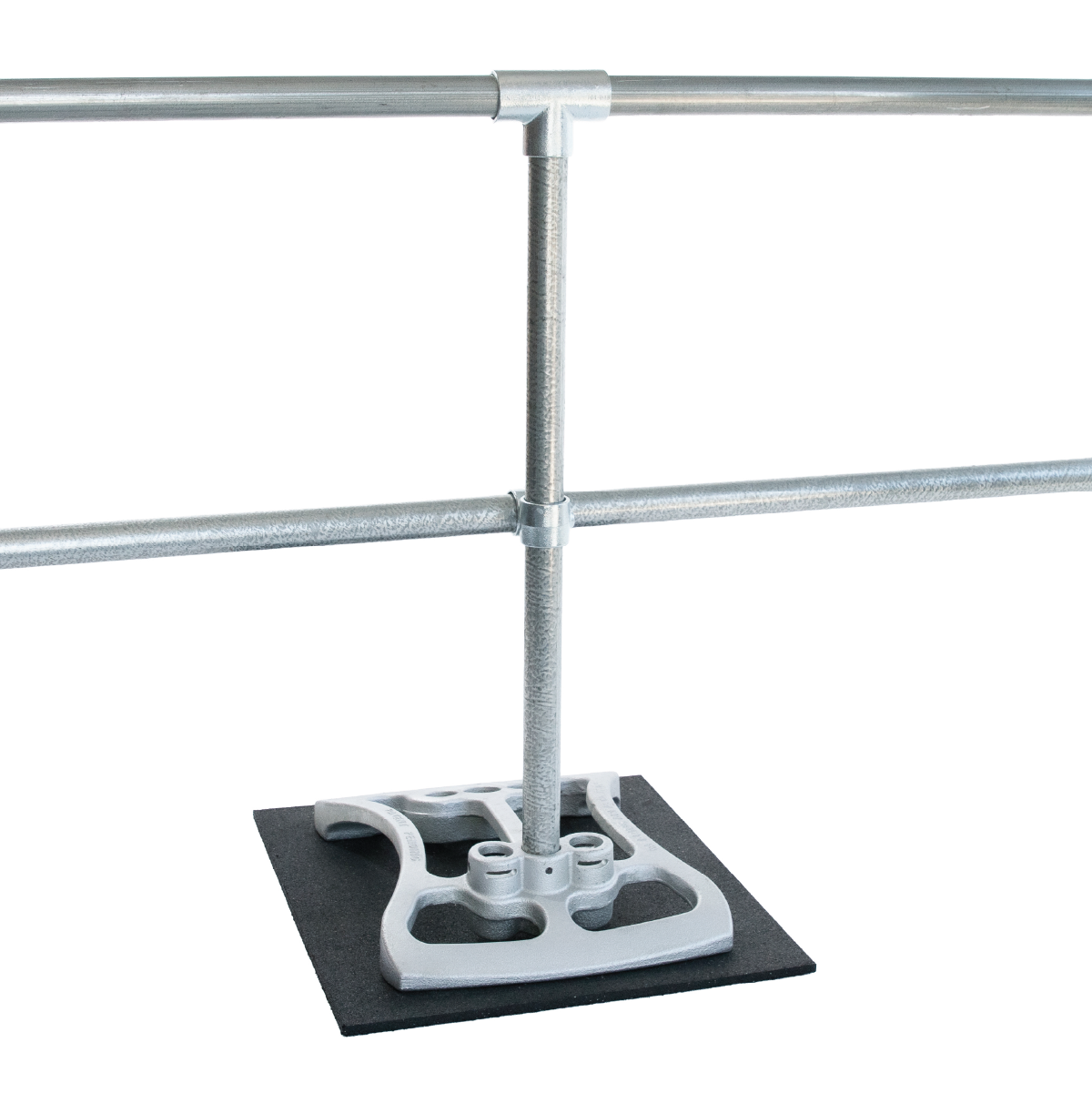
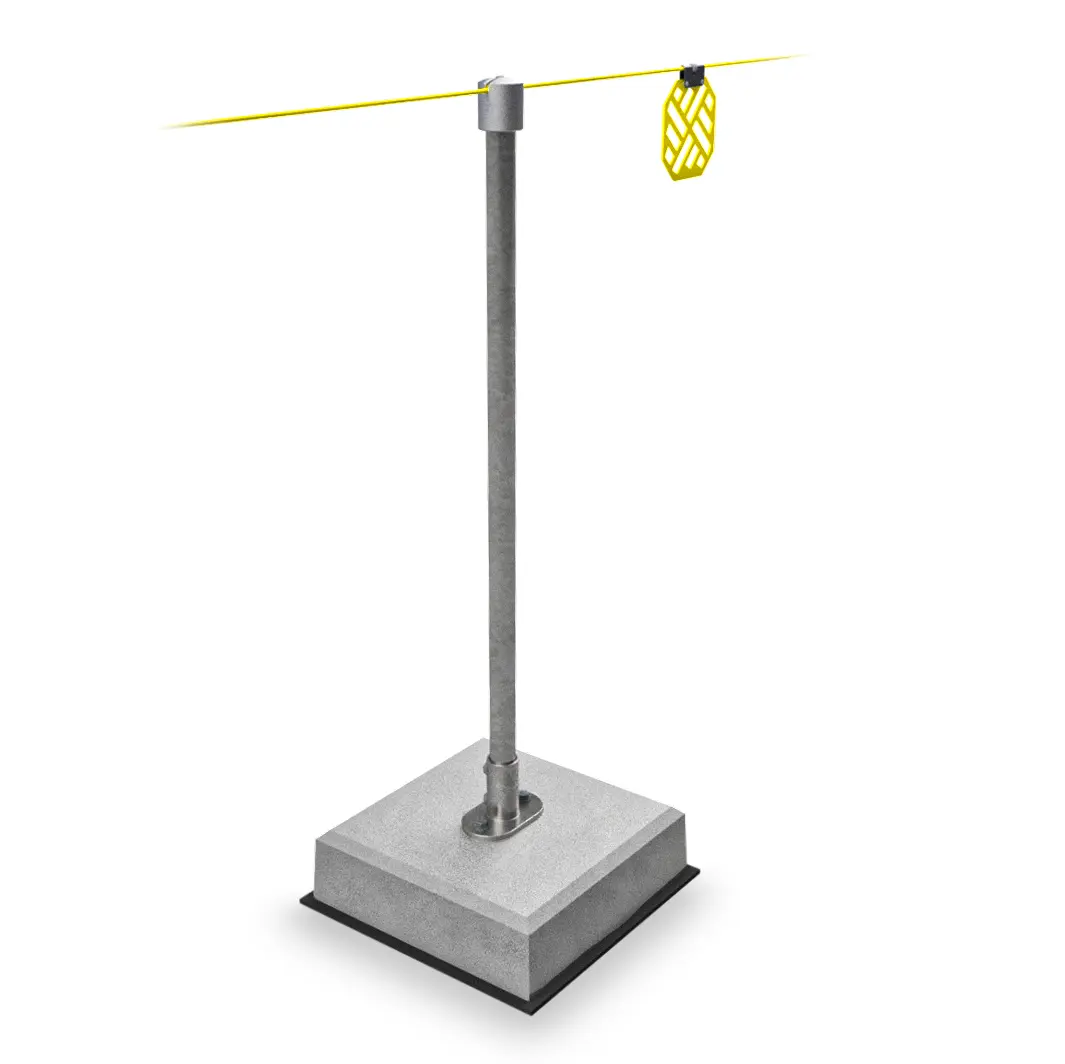
Stanchion spacing is determined by the system design, the line height and sag, the required resistance to tipping, and the manufacturer’s instructions. SafePro’s current Gen3 product layout, for example, uses intermediate stanchions at 24-foot intervals while placing flags at six-foot intervals.
The equipment must still satisfy every applicable OSHA performance criterion after it is assembled.
What a warning line does not do
A warning line is not a guardrail. It is designed to warn and delineate, not to withstand a person falling against it.
That means it should not be used:
- As a handrail or physical restraint
- As a substitute for guardrail where employees work within a prohibited distance of the edge
- On a roof or during work outside the situations allowed by the governing standard
- Without additional protection required for construction roofing work
- To protect roof openings unless the arrangement independently satisfies the rules for those openings
- As the sole basis for calling an entire rooftop compliant
- Without workers accessing the roof having been trained on the warning line’s meaning
If workers routinely cross the line, work between it and the edge, or treat it like a physical barrier, the selected control is probably mismatched to the work.
Warning line or guardrail?
The choice should follow the hazard and work pattern.
| Consideration | Warning line or designated area | Guardrail system |
| Primary function | Warns and defines a boundary | Physically guards an edge or opening |
| Employee behavior | Depends on workers remaining within the defined area | Provides passive protection without requiring connection to a personal system |
| Near-edge work | Restricted and governed by the applicable standard | Commonly used where work or travel occurs near the edge |
| Access for many trades | Requires continued control of who may cross the line | Often easier for routine access by multiple trades |
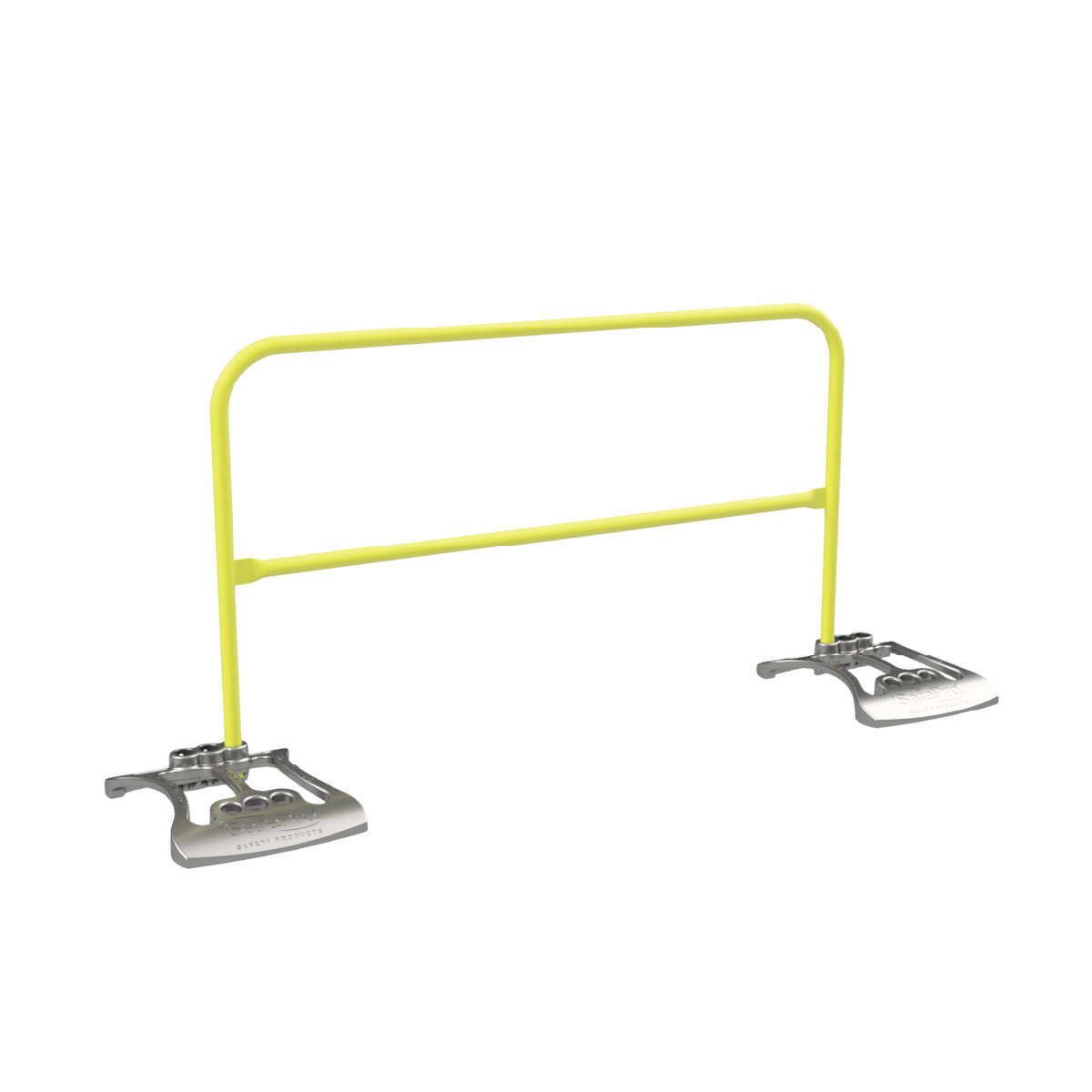
| Typical installation | Lightweight line and stanchion layout, sometimes ballasted | Engineered panel or component system, ballasted or attached |
| Best fit | Defined work areas set back from an edge | Recurring exposure, travel routes, equipment areas, openings, and roof perimeters |
Guardrail usually costs more and occupies more roof area, but it does not depend on a worker recognizing a boundary and staying behind it. Warning lines can be practical when the work and setback rules clearly allow them.
Planning a warning-line layout
A compliant layout begins before the material reaches the roof.
- Identify whether the work is general industry or construction.
- Confirm the roof qualifies as low slope under the applicable rule and the product is approved for the actual pitch.
- Map every unprotected edge, opening, access point, travel path, storage area, and equipment area.
- Determine whether the work is temporary, infrequent, or recurring.
- Establish the required setbacks before calculating material quantities.
- Account for mechanical-equipment direction of travel.
- Verify line strength, flagging, height, sag, stanchion resistance, and connection details.
- Confirm that the roof surface can support the bases and that the material is compatible with the roofing membrane.
- Plan how installers will remain protected while placing the system near existing fall hazards.
- Assign inspection, maintenance, and access-control responsibilities.
SafePro’s Warning Line System uses galvanized steel stanchions, plastic-coated steel cable, high-visibility flags, and ballasted bases with roof-protection pads. It is designed for configurations under OSHA 1910.29(d) and 1926.502(f), but the employer remains responsible for selecting a permitted use and installing the system for the actual work. If you’re interested in a warning line system for your building, contact us and our experts will be happy to assist ensure your site’s compliance.